With Webpublication, you can independently create a product catalog using InDesign and our online platform. Users have the option to add products to a Wishlist, which they can share or use to manage future orders.
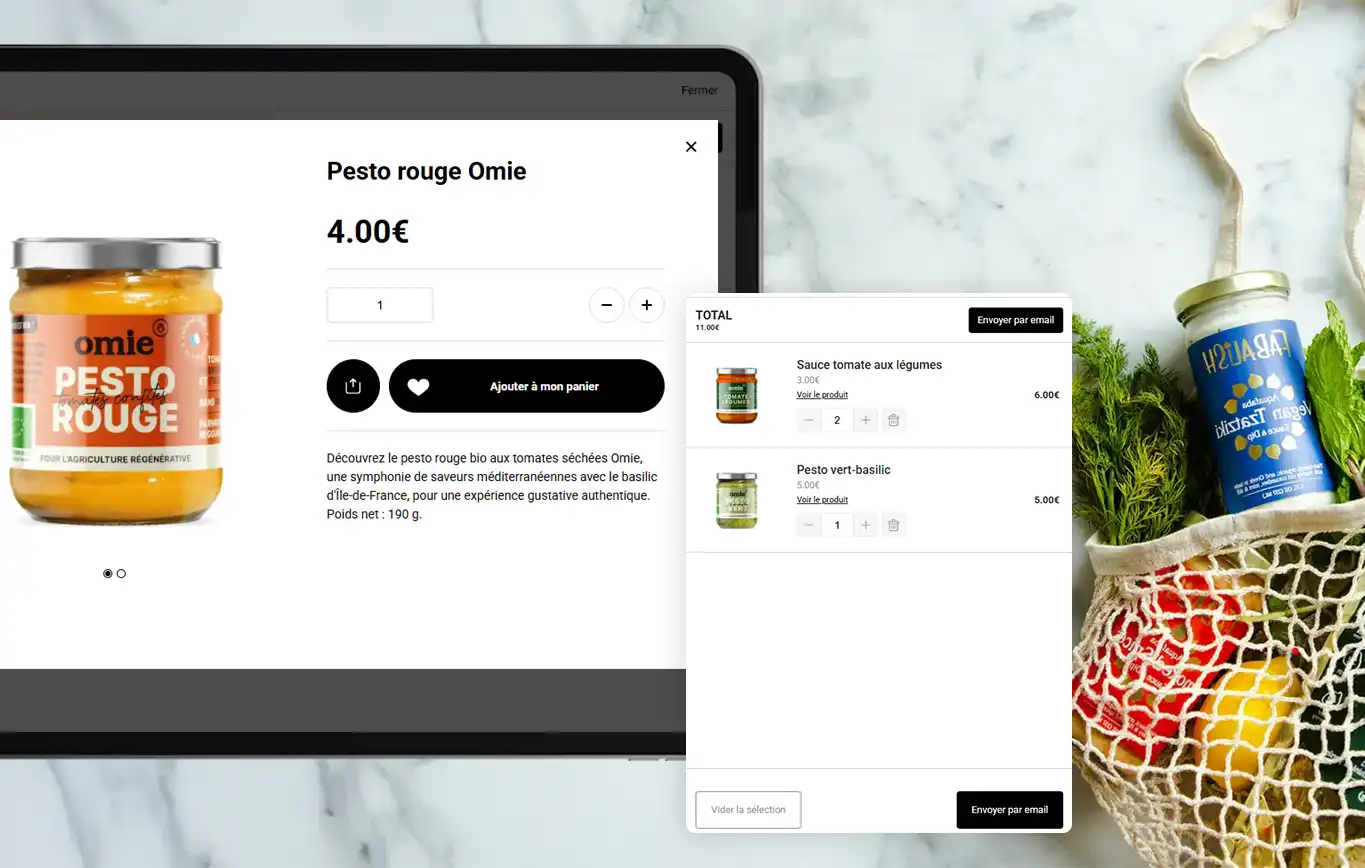
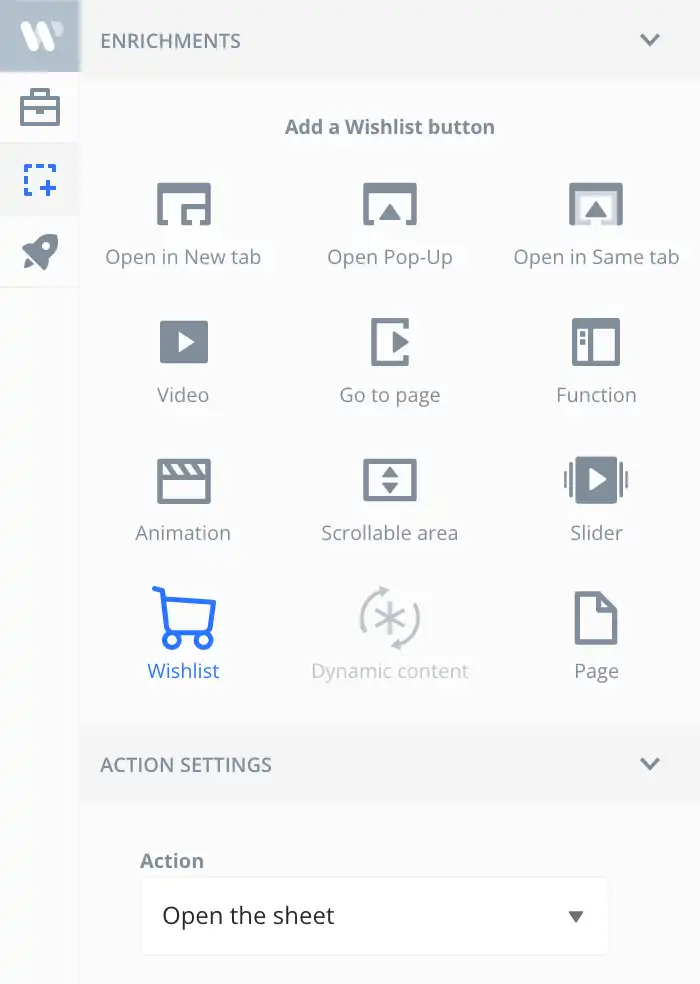
Scroll down for a Step-by-Step Video Tutorial, or continue reading and follow these instructions:
Part 1: Configuration in Webpublication
- Create the publication in InDesign using the plugin.
- Access the Webpublication Drive, find your publication, and click on Edit > Settings > Advanced Options > Wishlist.
- Check the box "Enable Wishlist."
- Upload the product information:
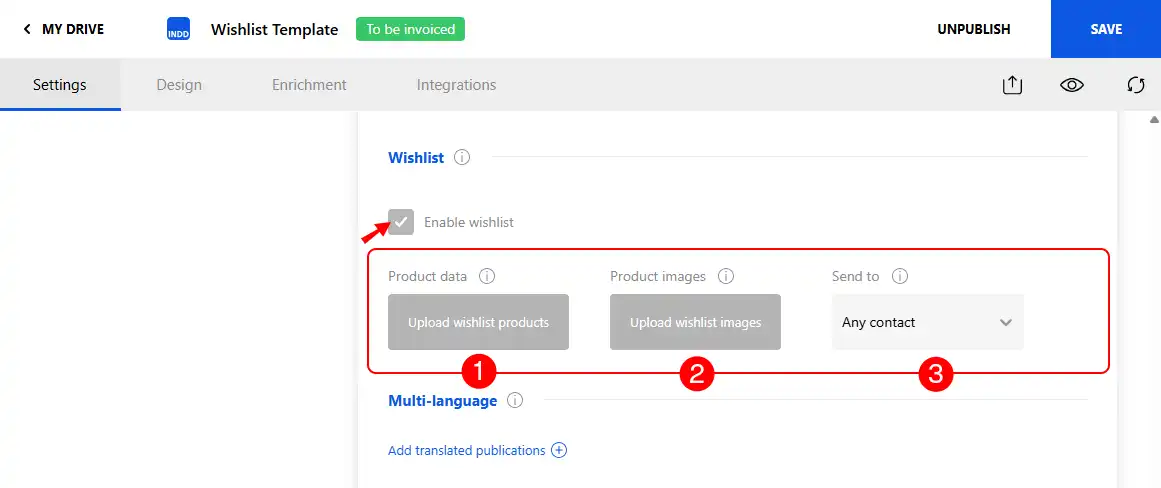
1. Product Data:
- Click on the "i" icon to download a sample Excel file.
- Fill in the file with your product data for the Wishlist. Each product must have a unique reference in the "ref" column.
- In the "Page" column, indicate the page number where the product appears in the catalog.
- In the "image" column, enter the file name of the product image.
- Modify the column headers as needed. The first two columns must always be "ref" and "Page."
- Click "Upload Products" to upload your Excel file. You can update this file at any time.
2. Product Images:
- Create a ZIP file with all the product photos. Make sure each file name matches the names entered in the "image" column of your Excel file.
- Click "Upload Images" to upload your ZIP file.
3. Send To:
- Choose between "Custom Contact" (the user can share the Wishlist by email with a specific contact) or "Distributor" (the user can share the Wishlist with predefined distributors or any chosen contact).
- If you choose "Distributor," a button will appear allowing you to upload your list of contacts. Download a sample Excel file by clicking on the "i" icon, then upload it using the "Upload Distributors" button.
Part 2: Setup in InDesign
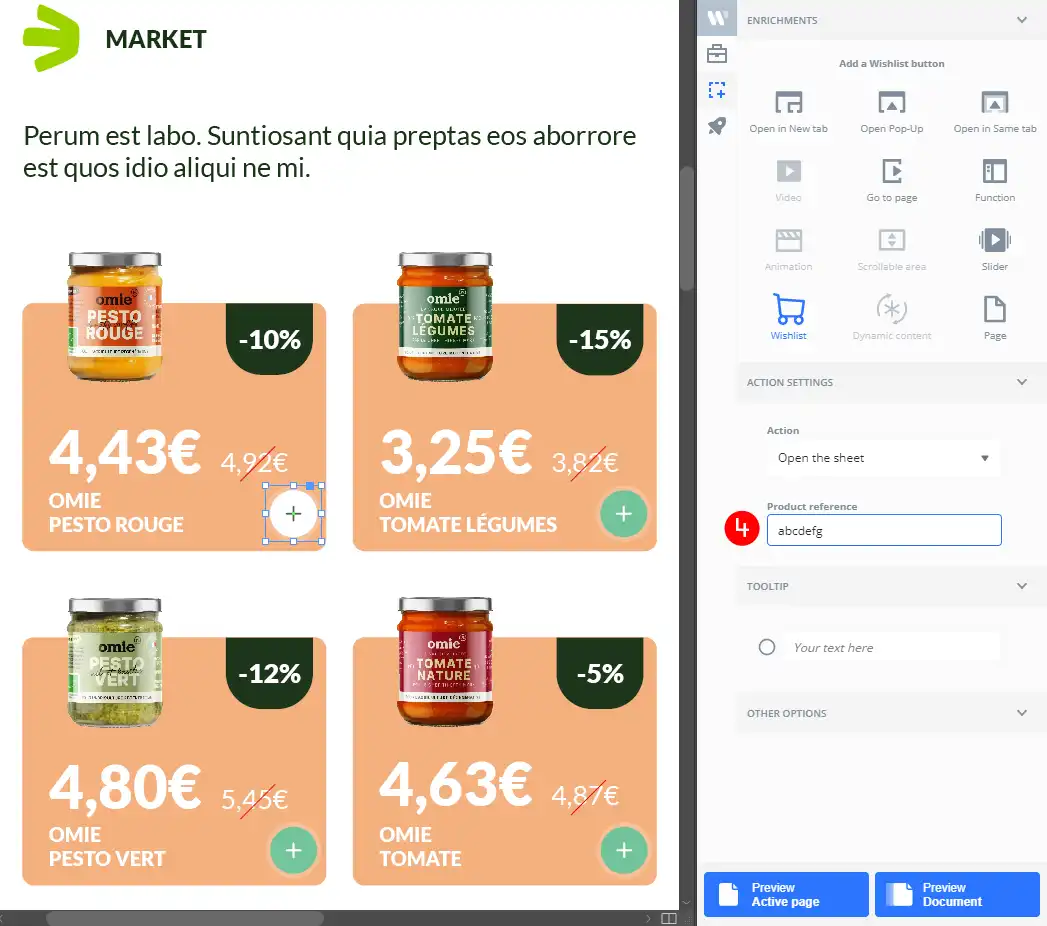
1. In InDesign, add a button to each product that allows users to add products to their Wishlist.
2. Select the button you created, then go to Enrichments > Wishlist in the plugin.
3. Under "ACTION SETTINGS," choose what the button should do:
- Open product card before adding the product to the Wishlist, or
- Add to cart directly to add it to the user’s selection.
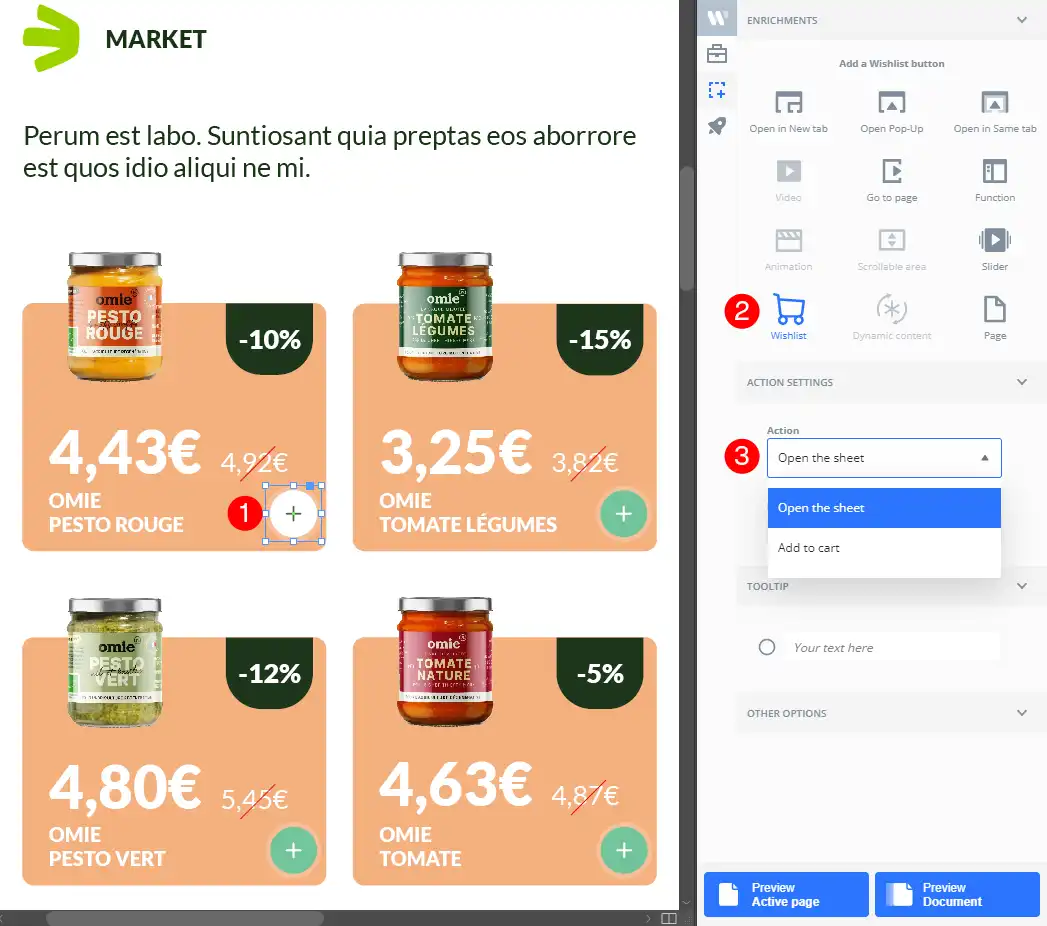
4. Enter the product reference, making sure it matches the value entered in the "ref" column of the Excel file.
5. Repeat these steps for all products.
Finally, click Project Finalization > Save Online when finished to update your project and activate your Wishlist.
IMPORTANT: The Wishlist is available at no additional cost for all clients subscribed to Webpublication’s Gold Plan. For other plans, please check our pricing page or contact your sales representative.
Step-by-Step Video Tutorial
Frequently Asked Questions
Note: Spreadsheet columns you can fill yourself are described below. For anything that needs a configuration change, contact our support team — they can apply basic setup for you, or assess whether your request is feasible and suggest possible solutions. Some needs may require a new feature beyond standard configuration; in that case, support will advise you on the options available.
Yes — no support setup needed. In the images column, list several file names separated by |:
images: 1.jpg|1b.jpg|demo.mp4
Supported media in the product card:
- Images (standard image files in your uploaded ZIP)
- Videos (
.mp4,.webm,.avi,.mov) - YouTube URLs (when the value contains
youtube.com)
Yes — no support setup needed. Use the Prix barré column for the previous price, and Prix for the current price:
| ref | Prix | Prix barré |
|---|---|---|
| SKU-1 | 19.90 | 29.90 |
The product card shows the current price with the previous price struck through.
Yes — no support setup needed for up to 3 quantity tiers. When the user increases quantity on the product card, the displayed price updates automatically.
| ref | Prix | discountQuantity1 | discountPrice1 | discountQuantity2 | discountPrice2 |
|---|---|---|---|---|---|
| SKU-1 | 10 | 10 | 9 | 50 | 8 |
Example: base price 10; from 10 units → 9; from 50 units → 8.
Requires support: more than 3 discount tiers, or custom column names.
Yes — different prices per variant are supported, but each variant is its own product row/SKU with its own Price. There is no “one product + price overrides by attribute” model.
How it works
- Rows that share the same
groupe filtrebecome a variant group. - Attribute dropdowns come from
nom filtre N/valeur filtre N. - Changing a variant select opens that variant’s SKU, so the page shows that row’s price, images, etc.
Spreadsheet structure (you can do this yourself)
One attribute (e.g. color only) works with the default setup. Different price for A vs B:
| ref | Nom produit | Prix | groupe filtre | nom filtre 1 | valeur filtre 1 |
|---|---|---|---|---|---|
| SKU-RED | T-Shirt | 19.90 | TSHIRT-01 | Color | Red |
| SKU-BLUE | T-Shirt | 24.90 | TSHIRT-01 | Color | Blue |
Same group, different ref + Prix + filter value.
Two attributes (e.g. color + size): prepare one row per combination in your spreadsheet, then ask support to enable the second filter:
| ref | Prix | groupe filtre | nom filtre 1 | valeur filtre 1 | nom filtre 2 | valeur filtre 2 |
|---|---|---|---|---|---|---|
| SKU-RED-S | 19.90 | TSHIRT-01 | Color | Red | Size | S |
| SKU-RED-M | 19.90 | TSHIRT-01 | Color | Red | Size | M |
| SKU-BLUE-S | 24.90 | TSHIRT-01 | Color | Blue | Size | S |
| SKU-BLUE-M | 24.90 | TSHIRT-01 | Color | Blue | Size | M |
Price is always per SKU/row — so if only color changes price, still duplicate rows for each size; just set the same price on Red/S and Red/M.
Requires support: enabling a second (or further) variant attribute. Contact our support team with your spreadsheet and we will configure it.
Yes. Related products appear in the footer of the product card. Clicking one opens that product.
Unlike variants (same product family with Color/Size selectors), related products are cross-sells — other products you want to suggest.
Requires support: related products need a short configuration step by our team. Once enabled, you maintain the links in your product spreadsheet.
How you prepare the data
Option A — Manual list of references (most common): add a column with pipe-separated product refs:
| ref | Nom produit | related |
|---|---|---|
| SKU-A | Chair | SKU-B|SKU-C |
| SKU-B | Cushion | SKU-A |
| SKU-C | Table | SKU-A |
Relations can be bidirectional: if A lists B, B can also show A automatically, so you often only need to list one direction.
Option B — Automatic by shared property: products that share the same value (for example the same collection or brand) can be linked automatically. Tell support which column to use.
Contact support with your preferred option and a sample of your spreadsheet; we will enable related products for your publication.
These spreadsheet columns work out of the box (no support setup needed):
| Column | What it does |
|---|---|
ref | Unique product reference (required) |
page / pages | Catalog page(s); use | for several pages (e.g. 2|3) |
Nom produit | Product title |
Prix | Current price |
Prix barré | Previous / strikethrough price |
Descriptif | Main description (HTML allowed) |
Descriptif2 | Secondary description |
images | Image/video file names, separated by | |
Logo marque | Brand logo image file |
Picto | Small icons under the description, separated by | |
groupe filtre + nom/valeur filtre | Product variants (one attribute by default) |
discountQuantityN / discountPriceN | Quantity-based prices (1–3) |
Need a custom column name, an extra field, or a feature not listed here? Contact support — most Wishlist customizations are possible with expert assistance.
Yes. The Wishlist can hide several elements of the product experience:
- Prices (product card, search, and cart)
- Empty / missing prices (show a dash instead of 0)
- Quantity selector
- Product reference (SKU)
- Product image in the cart
- Product card pages / deep links
Requires support: these options are configuration toggles. Contact our support team and tell us which elements you want hidden; we will apply the settings for your publication.



No comments.